Beach Safety
Flag Forecast is updated daily by the National Weather Service (NWS) from April - October. Local flag conditions may be different from the NWS forecast due to locally observed conditions.
Generally speaking, the beach is a safe, beautiful place to enjoy. However, as with any natural wonder, accidents can happen; and the ocean can pose potential risks if not respected or enjoyed properly. The best way to make sure an experience remains good, is to know what to do if the circumstances turn bad.
Beach Rules
Before setting out on your beach visit, please take a few moments to review the safety information provided below:
Beach Warning Flags & Lights
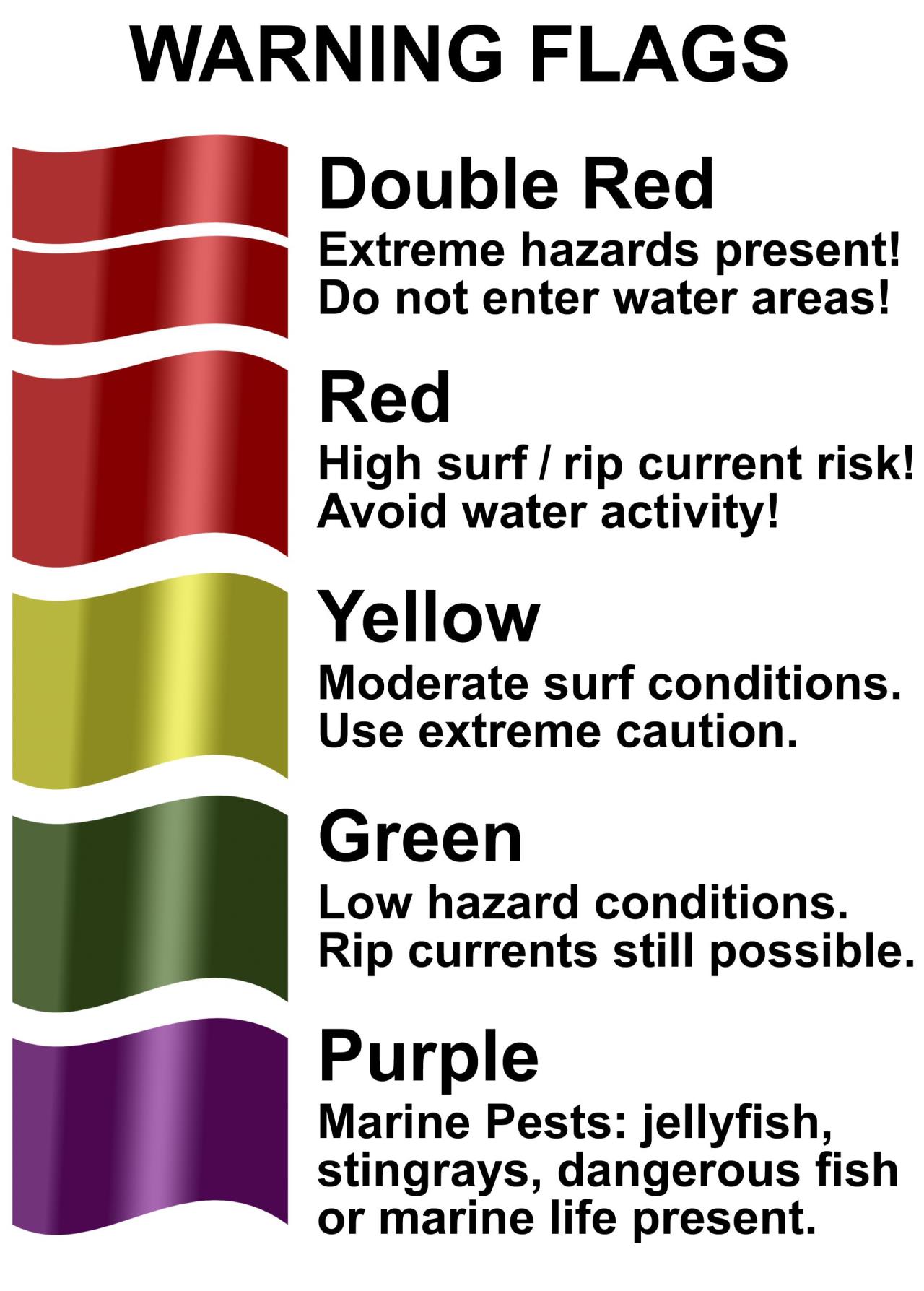
The Town of Oak Island utilizes a 5-Flag warning system for beach conditions, which are displayed through physical flags(JPG, 87KB), QR codes(JPG, 628KB) and lighted signage(JPG, 215KB).
The meaning of the color for each flag is listed below:
- Double Red: Do not enter water
- Red: Do not swim in water
- Yellow: Use extreme caution
- Green: Always use caution
- Purple: Dangerous fish or stinging marine life present
Purple Flag Note
Like almost any beach in the world, there are always sharks, jellyfish, and other potentially dangerous marine life in the water. The rare possibility of encountering one of these must be accepted before swimming in the ocean.
In most cases, sightings of a shark or other marine life will not trigger a purple Beach Warning Flag(JPG, 200KB); only when they have been observed in an unusually high concentration, very close to shore, or other unique circumstances will a purple flag be raised.
To learn more about Oak Island wildlife that can be seen both in and out of the water, visit the Wildlife Information page.
Physical Flag Locations
- Mounted on all of the Beach Safety Unit and Fire Department vehicles
- Fire Station 1 (101 E Oak Island Drive)
- Fire Station 2 (8510 E Oak Island Drive)
- The volunteer Oak Island Water Rescue Station (SE 49th St.)
- Crossroads Gathering Place at the base of the GV Barbee bridge
QR Codes
Flag conditions can also be accessed by scanning the QR code found on any Beach Access Location signage.

Lighted Signage
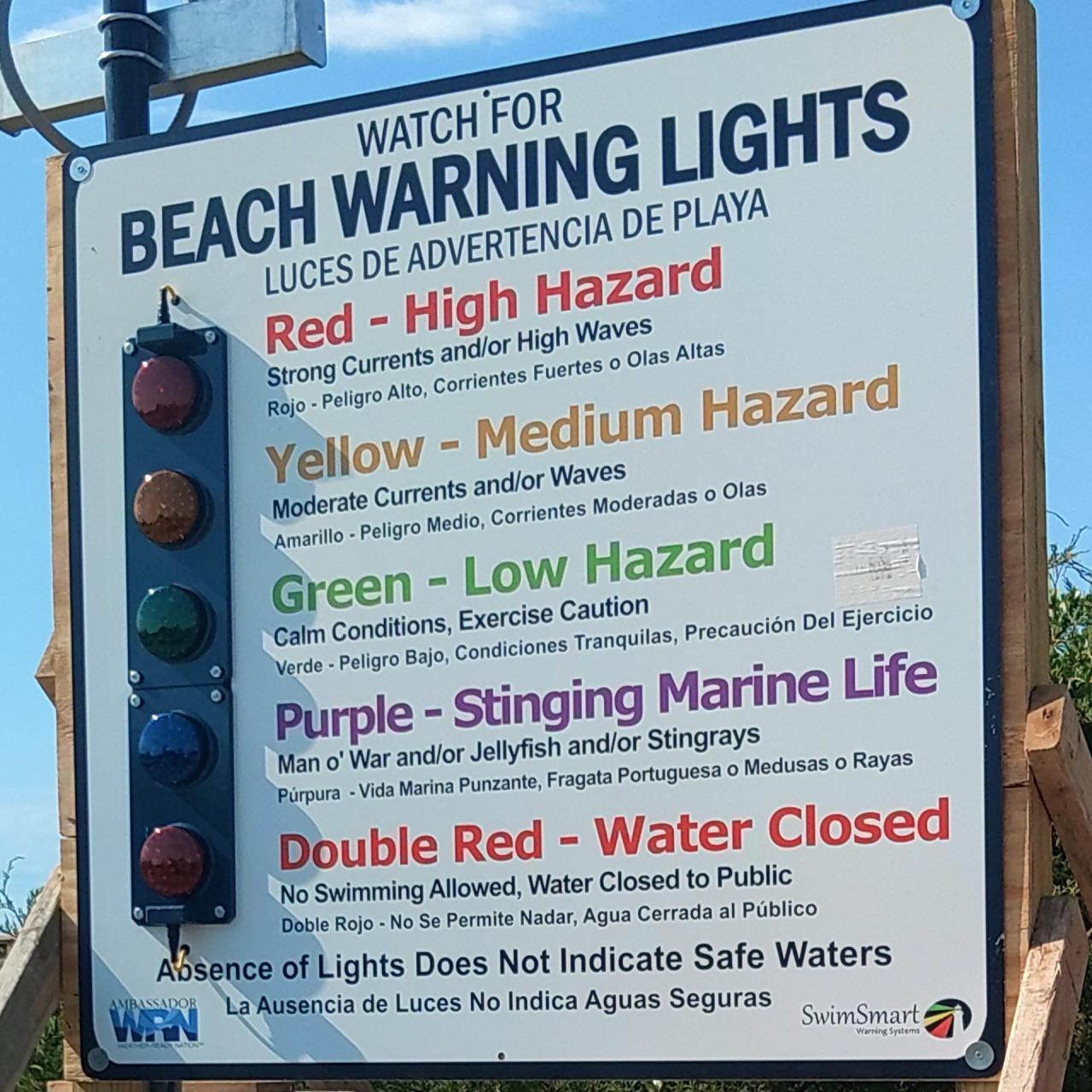
Oak Island is the first Town in the Carolinas to use lighted Beach Warning Signs, featuring a wireless control system which automatically updates conditions from the National Weather Service.
The signs are installed in the Beach Access Locations at the more heavily trafficked areas of:
- Barbee Boulevard (near the Oak Island Pier)
- Oak Island Cabana (Middleton Park Complex)
- 3rd Place East (near S Middleton Ave.)
- The Point (end of W Beach Dr.)
Notice: An absence of lights on a sign does not mean the water is safe.
Digging Large Holes
Each Summer season, the Oak Island Beach Safety Unit fills in hundreds of large, deep holes left unattended on the public beach areas. Deep holes in the sand can be dangerous to beachgoers, wildlife, and Beach Safety crews responding to emergencies. At well over 100 lbs. per cubic foot, the weight of sand from a collapsed hole can immediately crush most children, small pets, and wildlife. Often difficult to see when left unattended, and nearly impossible to see at night, these hazards regularly lead to damaged emergency equipment and severe injuries for people, pets, and wildlife walking along the beach.
In response to the call volume and overwhelming safety concerns, on July 8, 2025 the Oak Island Town Council approved an update to Ordinance 14-142, which will now limit the depth and tools used to dig recreational holes on the public beach areas.
As noted in the new Ordinance Amendment, Holes dug on the beach strand:
- Cannot be deeper than 12”
- Can only be dug using toy shovels intended for use by children
- Must be attended at all times, and completely filled in by 6:00 PM
Violation of this ordinance can now result in a $50 fine, issued by the Beach Safety Unit or the Oak Island Police Department.
To educate beachgoers on the ordinance update, the Town is inviting everyone to help say “Goodbye to Deep Holes(PNG, 776KB)” — through this effort, the graphic below will be shared with accompanying information on multiple visitor-targeted pages of the Town Website, as well as social media platforms and on roadside billboards.

Emergency Vehicle Access
Across the 65 public Beach Access Locations within Oak Island, approximately 23 are designated Emergency Vehicle Access Locations.
These special locations feature a wider path over the dunes and modified parking lot design, to accommodate emergency response vehicles.
The access paths at these locations must remain open and unobstructed at all times!
“Keep paths free, from street to sea!”
This includes equipment on the beach as well. Tents, chairs, and blankets and other personal items should not be placed in the path on the beach side of the dunes as well.
Emergency Vehicle Access Locations
- McGlamery Street
- Trott Street
- Barbee Blvd.
- SE 76th Street
- SE 70th Street
- SE 64th Street
- SE 63rd Street
- SE 52nd Street
- SE 49th Street
- 35th Place East
- 32nd Place East
- 29th Place East
- 25th Place East
- 19th Place East
- 16th Place East
- 9th Place East
- 3rd Place East
- 5th Place West
- 13th Place West
- 23rd Place West
- 30th Place West
- 48th Place West
- 54th Place West
- The Point (End of W Beach Dr.)

Heat Safety
As a popular Summertime destination, extreme heat can often be a concern.
Even if the National Weather Service has not issued a Heat Warning or Advisory, caution and awareness should still be used when on the sand in the Summer heat.
Remember to:
- Drink plenty of water, and avoid beverages with alcohol.
- Apply SPF 30 or higher sunscreen every two hours
- Wear lightweight, light-colored, and loose-fitting clothing.
- Stay in the shade as much as possible.
- Please keep pets and small children off the sand during the heat of the day.
Most importantly if you or someone around you is starting to experience signs of #HeatStroke (including throbbing headache; confusion; slurred speech, and rapid, strong pulse), don’t wait until it’s too late, call 9-1-1 immediately.
Life Jackets & PFDs
U.S. Coast Guard approved Life Jackets or Personal Floatation Devices (PFDs) are required in many cases for any activities which might take you from the shore, such as boating, paddle boarding, wind surfing, kite boarding or similar.
When not required by law, they are still strongly encouraged!
Life jackets are also recommended for small children or non-confident swimmers who go further than waist deep into the ocean.
Remember: Even if they are wearing a life jacket, never leave children unsupervised in the ocean, and if you see someone in distress call 9-1-1 first — before retrieving a Rescue Tube and entering the water to assist.
Rafts / Inflatables vs. PFDs
Do not let “flotation devices” such as rafts, inner tubes, or arm-floats create a false sense of security! Non-USCG approved flotation devices are toys, and not meant for lifesaving.
These devices can pose risks if used in place of a PFD. Passengers can slide off, be flipped over, or even carried away from shore due to strong wind or currents.
Similarly, “arm floats” can actually slide down the arms, creating greater concerns of “trapping” small children.
USCG approved devices are specifically tested to ensure safety; with Type I jackets being designed to keep an incapacitated person's head and face up out of the water.
Note: With any device, a child or incapacitated swimmer can still float into deep water. That is why it is important to remain aware of your surroundings, including present water conditions.
Rip Current Safety
For more information on Rip Current Safety from the National Weather Service, view the NWS Rip Current Awareness page.
Beach safety and rip current education is a major part of the efforts undertaken by the Town of Oak Island. Information we promote largely comes from the National Weather Service.
As the instructional video below notes, when caught in a rip current:
- Stay calm! Rip currents don't pull you under - just out.
- Do not try to swim directly back to shore. Swim with the shoreline (parallel) until you escape the current's pull.
- When free from the pull of the current, swim at an angle away from the current toward shore.
- If you feel you can't reach shore, relax, face the shore, and call or wave for help.
- Remember: If in doubt, don't go out!
Safety Near the Piers
Important: Swimming, surfing, and all in-water activity under, beside, or immediately near a Pier is dangerous and prohibited!
Town Ordinance 22-12 prohibits swimming or other in-water activity within 250 ft. of the Pier, and Section 22-5 further extends this for surfing to 350 ft. away.
Why? There are many hazards around a pier which can lead to serious personal injury, including fishing lines, fishing hooks, and larger predatory fish.
Additionally, barnacles and other crustacean growth, along with pushing waves and swift currents can make the support pilings underneath a pier extremely dangerous!
What to do: To help ensure a safe distance for in-water activity, start at the Pier and take about 100 “big steps” away. This is an approximate way to measure enough distance to help avoid hazards.
The Town of Oak Island is home to two (2) ocean piers, the privately owned Ocean Crest Pier, and the Town-owned Oak Island Pier (pictured below).
To learn more about the Oak Island Pier, visit our Oak Island Pier page.

Sand Dune Protection & Safety
The sand dunes (also called “berms”) protecting the seashore can be a place of potential safety concern for both humans and wildlife!
Walking, running, playing, climbing, or any other traffic of any kind on or across the sand dunes (except where designated) is prohibited!
Why? This is to ensure both dune stability and personal safety. There are posts, fencing, shells, and vegetation within the dunes that could cause injury, as well as the risk of falling.
Additionally, several species of local wildlife use the dune system as a vital part of their habitat.
Designated Access Pathways over the dunes are clearly marked at each Beach Access Location, and feature post-and-rope guides(JPG, 268KB) like the example shown below:

Swimming Advisories
 In most cases, advisories will not be issued during the non-swimming season from November 1 - March 31.
View any Swimming Advisories.
Water quality in the surf areas along Oak Island is regularly tested as part of the NC Recreational Water Quality Program, administered by the Department of Environmental Quality (NCDEQ).
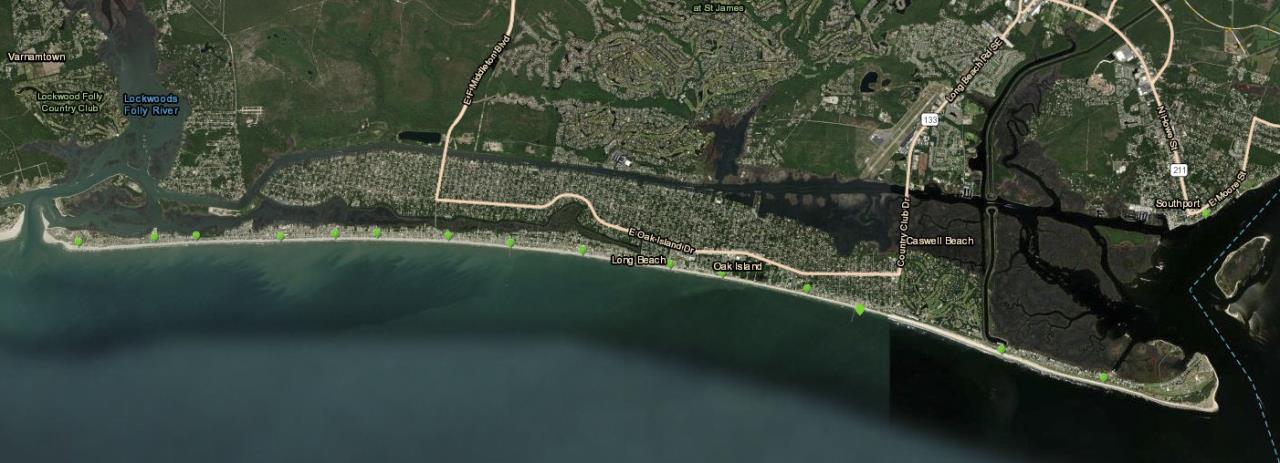
The program conducts testing at 11 sites in the Town of Oak Island, and two in neighboring Caswell Beach, for enterococcus bacteria. This is an “indicator organism” that does not cause illness, but is an indicator of organisms that can.
Most sites are tested on a weekly basis during the swimming season of April through September, twice a month in October, and monthly from November through March.
Select the map below to view recent testing results by location:
Swimming Advisory Levels
If testing shows bacteria levels are significantly elevated, NCDEQ may issue a Swimming Advisory in one of the following levels:
- No Pending Swimming Advisory means that enterococci levels are within the EPA standards for swimming at this particular monitoring site.
- Precautionary Advisory – stormwater discharge area, including areas impacted by excessive rain events.
- Pending Swimming Advisory means that enterococci levels are elevated. The results from a second water sample will determine whether a Swimming Advisory will be issued or if the Pending Swimming Advisory is rescinded.
- Swimming Advisory means either that enterococci levels have exceeded EPA Standards for two consecutive tests or that enterococci levels of five samples collected within 30 days exceeds EPA standards.
Rescue Tube Stations
 Through an ongoing partnership with the Jack Helbig Memorial Foundation, the Town of Oak Island provides Water Safety Stations at all 65 of the public Beach Access Locations.
Each Station consists of two (2) main components:
- Beach Warning Flag & instructional sign
- A yellow “Rescue Tube” personal floatation device
Note: Rescue Tubes & Beach Warning Forecasts are only installed during the summer months, when Beach Warning Flag forecasts are provided by the National Weather Service.
Reading a Station Sign
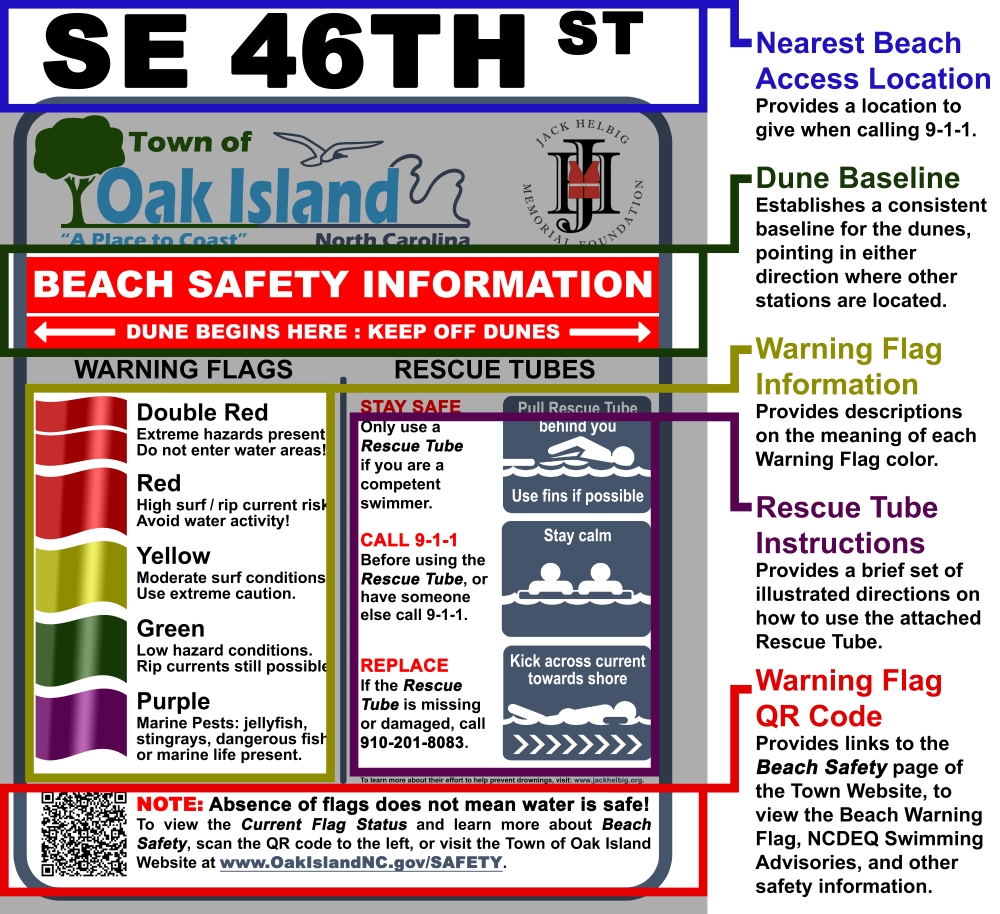
The Water Safety Station signs provide five (5) key points of information that is critical during an on-beach emergency, including:
- The station's street location (to provide telecommunicators with when calling 9-1-1)
- The location relative to other stations (at the baseline of the dunes)
- Descriptions of the Beach Warning Flag colors
- Instructions on how to use the attached Rescue Tubes
- Links on how to find the current Warning Flag status and forecasts.
Provided below is a breakdown of where to find these information points(JPG, 628KB):
Wildlife (Jellyfish, Man O' War, Fish / Sharks, etc.)
With a diverse ecosystem of wooded forests, swamps, coastal marshes, and sandy beaches, there is no shortage of wildlife to be found in the Cape Fear region! In fact, there are hundreds, if not thousands of species of birds, fish, reptiles, amphibians, insects, and arachnids that call Oak Island home.
To learn more about the variety of species that you may encounter in the beach and surf areas, visit our Wildlife Information page.
“Don’t Panic!” … But How?
It takes more than just saying the words ‘don't panic’ to keep from panicking!
It's a common response. You're out swimming, paddling a kayak, sitting on a surfboard, or any number of other activities on the water, and then it happens; you realize you're way too far from shore. You try to head back in, but the current, the wind, the waves... they're all making it just too difficult.
Before you know it, the shore seems to be pulling away from you even farther. Your eyes start darting around looking for a way back. Your breathing gets shallow and rapid; heart rate increases. You're confused, jittery, and can't think clearly; feeling so... overwhelmed.
Realizing you're on the edge of a potential emergency can be a terrifying experience, and even though the first rule of response is "don't panic" – it rarely helps to just hear those words.
So how do you keep from panicking?
There are several basic steps to help maintain personal safety when you don't know what to do.
- Find your “focus.” In a panic, your brain is trying to process many things at once, and as a result is not able to do any single task well. Remember there is only one goal to start with: breathing. Stay focused on that task, and try to "tune out" all of the other sensory overload that can come with panic. Whether it's staying on your board or simply floating along, do the things needed to keep your focus on the task at hand. Once you have that under control, then you can shift your focus to other goals, like trying to call for help.
- Keep breathing. Remember to consciously take long, deep breaths, to help override the shallow breathing brought on by your body's “fight or flight” response.
- Don't “abandon ship.” If you're on a boat, board or other floating equipment, you may be tempted to jump off to and "swim faster" without it: don't! You are far safer to stay on something already floating and wait for help than you are relying on your own stamina to stay afloat.
- Lay back, float on. If you don't have the benefit of something that floats nearby, that's OK! Just become your own floatation device:
- Pull your shoulder back (this lifts your chest and helps raise your abdomen and legs to the surface)
- Keep your body straight and flat
- Push your chin up
- Breathe slowly and deeply
- Try to with slow movement of limbs
- Follow directions. When help does arrive, some of the instructions they give you may seem to go against your natural instincts. Remember: they are professionals who are operating off of extensive training and experience. They are looking at the situation from an "outside perspective" and are not under the same stresses as you. Following their directions exactly how they give them, is the fastest way to resolve your emergency!
Finally, remember Educate Yourself. The easiest way to remain calm in an emergency is to be confident that you already know what to do. Thoroughly read the information provided on this page, and understand the potential risks involved in a day on the water; and how to prepare or (if need be) react.